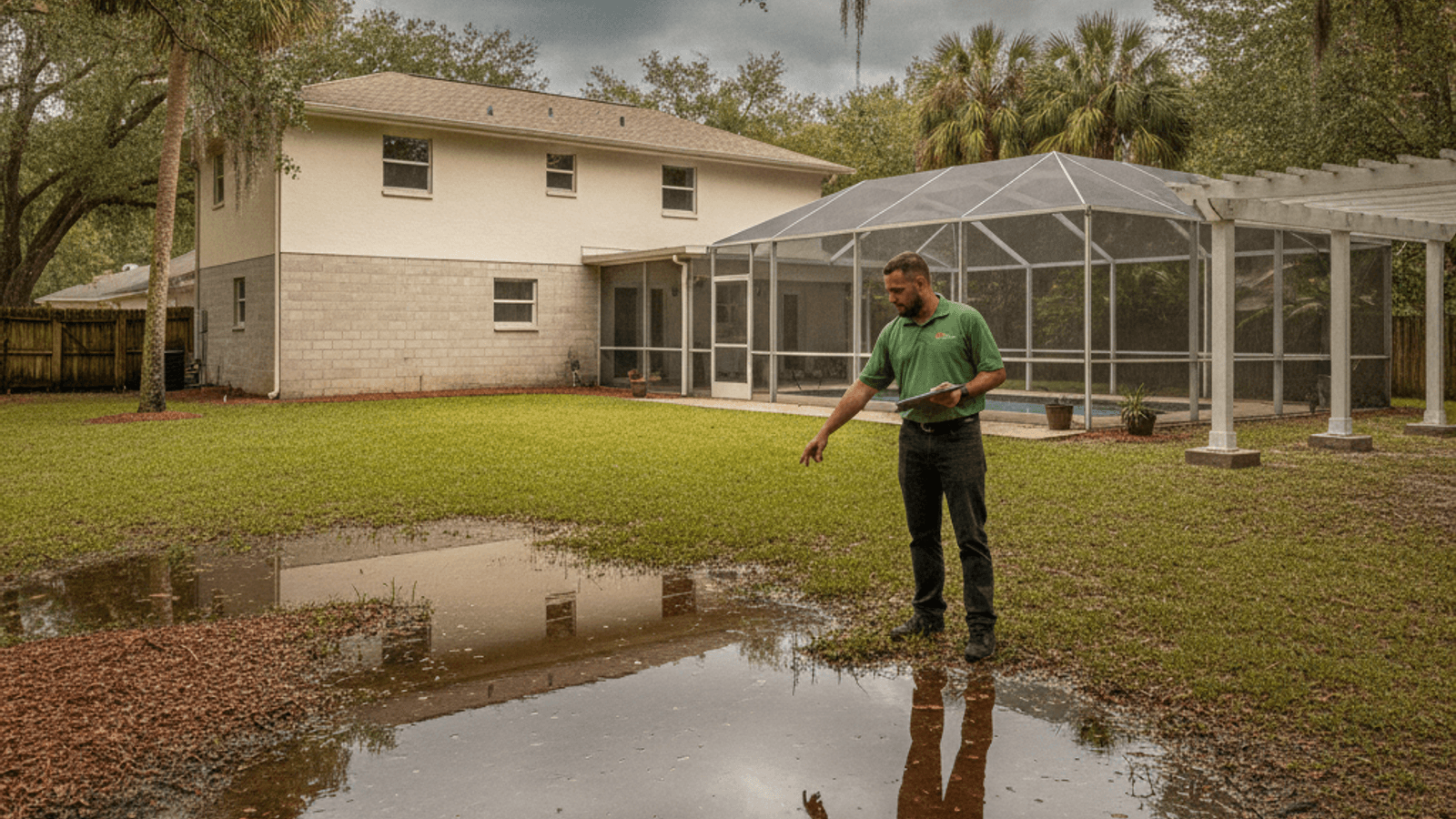
Central Florida’s sandy soil has a reputation for draining fast, and most of the time it does. So when a homeowner sees water sitting in the yard for hours or days after a typical summer afternoon storm, the instinct is often confusion rather than immediate diagnosis, since sandy soil isn’t supposed to hold water like that. It’s a fair reaction, but it’s also a solvable problem once you understand what’s actually causing the standing water in a soil type that should be draining it away.
Why sandy soil sometimes stops draining well
Sandy soil drains well when water has a clear path down and away. Two things commonly interrupt that path: compaction and grading. Compacted sandy soil, common in areas that were graded, driven over by heavy construction equipment during a home’s original build, or repeatedly walked and mowed over years, loses much of the pore space that lets water pass through quickly. What looks like sandy soil on the surface can behave more like a denser soil underneath once it’s been compacted enough.
Grading is the other major factor, and it’s often the bigger one. If the yard’s slope directs water toward a low point instead of away from the house and toward a proper drainage path, water pools there regardless of how well the soil itself would otherwise drain, since it’s arriving faster than gravity alone is moving it through the compacted or naturally slower-draining layer beneath.
The daily summer storm pattern makes this worse
Central Florida’s near-daily summer thunderstorm pattern, often building by early afternoon even on a clear morning, means a yard with a drainage issue doesn’t get much recovery time between rain events during peak summer months. A grading problem that might only cause occasional standing water in a drier climate becomes a near-daily nuisance here from June through September, which is exactly why drainage problems tend to get noticed and reported most during that stretch of the year.
Reading where the water is actually sitting
Where standing water collects tells you a lot before a contractor ever shows up. Water pooling against the foundation or along the side of the house usually points to grading that slopes toward the home instead of away from it, a genuine concern since prolonged moisture against a foundation can lead to bigger problems over time. Water pooling in a specific low spot in the middle of the yard, away from the house, more often points to a natural or graded depression that needs either regrading or a drainage solution routed through it. Water that sits near a retaining wall or sloped area, particularly out toward the rolling terrain of west Lake County, can point to a wall or slope drainage system that isn’t moving water through as designed.
What a French drain actually does and doesn’t do
A French drain is one of the most common fixes for standing water, a buried perforated pipe surrounded by gravel that collects water and redirects it to a proper discharge point away from the problem area. It’s effective for a specific type of problem: water that’s arriving at a low point and needs somewhere else to go. It’s not a fix for a grading problem where the entire yard slopes the wrong direction, since a French drain intercepts water passing through its specific location rather than correcting the broader slope of the property.
This distinction matters because a French drain installed in the wrong situation, treating a whole-yard grading problem as if it were a single-point drainage issue, often doesn’t resolve the standing water complaint even though it was installed correctly for what it actually does.
Getting a proper diagnosis before a fix
A drainage and grading assessment worth paying for actually maps how water moves across your specific lot during and after a storm, not just where it ends up sitting once the rain stops. That usually means a contractor walking the property during or right after a heavy rain, checking your downspout discharge points, and tracing the yard’s actual slope relative to the house and any neighboring lots that might be draining onto yours. Skipping that diagnosis and jumping straight to installing a French drain wherever water happens to be sitting is how homeowners end up paying for a fix that doesn’t actually solve the problem.
When regrading is the real fix
If water is pooling broadly across a yard, or specifically against the house along an extended stretch rather than at one isolated point, regrading is usually the more complete fix. That means reshaping the yard’s slope so water consistently moves away from the home and toward an appropriate discharge point, whether that’s a swale, a storm drain connection, or simply a lower area of the property designed to handle it. Regrading is a bigger project than installing a French drain, but it addresses the actual cause rather than routing around a symptom.
Why this matters more in newer developments than you’d expect
It’s a common assumption that a newer home built to current code automatically has correct drainage, but grading issues show up regularly in newer Central Florida communities too, sometimes because a lot’s final grade wasn’t properly established after construction equipment compacted the soil, or because a builder’s standard grading plan didn’t fully account for how water moves across that specific lot relative to its neighbors. Homeowners in growth corridors like Horizon West and Hunters Creek sometimes deal with drainage complaints within the first couple of years of moving into a brand new home for exactly this reason.
A quick check you can do yourself first
Before calling anyone, walk your yard during or right after the next heavy storm and note exactly where water is sitting, how it’s moving or not moving, and whether your downspouts are discharging water toward the problem area or away from it. A phone photo timestamped during active rain is more useful to a contractor than a description given days later once everything has dried out and the visible clues are gone. This won’t tell you whether the fix is a French drain or a full regrade, but it gives whoever diagnoses the problem a real starting point instead of a guess.
What happens if you ignore it
Standing water that sits for more than a day after a storm isn’t just an inconvenience. It’s a mosquito breeding concern in Central Florida’s climate, it can stress or kill grass and landscaping in the affected area, and if it’s pooling near the foundation, prolonged moisture exposure is a real long-term risk to the structure itself. A drainage problem doesn’t resolve on its own, and each subsequent storm season it goes unaddressed tends to make the eventual fix, whether regrading or a full drainage system, more involved than it would have been catching it early.
Why is water pooling in my yard if the soil is sandy?
Compacted soil or a grading problem is almost always the real cause, not the soil type itself. Compacted sandy soil loses the pore space that normally lets water drain through quickly, and grading that directs water toward a low point overrides sandy soil’s natural drainage advantage.
Will a French drain fix all my yard drainage problems?
Not always. A French drain works well for water collecting at a specific point but doesn’t correct a broader grading problem where the whole yard slopes the wrong direction. Diagnosing which type of problem you have determines whether a French drain or regrading is the right fix.
How urgent is a drainage problem near my foundation?
Take it seriously. Water pooling against the foundation for extended periods after storms is a genuine long-term risk to the structure, not just a cosmetic yard issue, and it’s worth addressing before the next hurricane season rather than after.
Do newer Central Florida homes have drainage problems too?
Yes. Grading issues show up in newer developments regularly, sometimes from construction equipment compacting soil or a standard grading plan not fully accounting for how water moves across a specific lot.
Dealing with standing water in your yard after every storm and want to know if it’s a grading issue or something a French drain can actually fix? Call (407) 000-0000 and we’ll connect you with an experienced, insured local crew that diagnoses before it quotes.