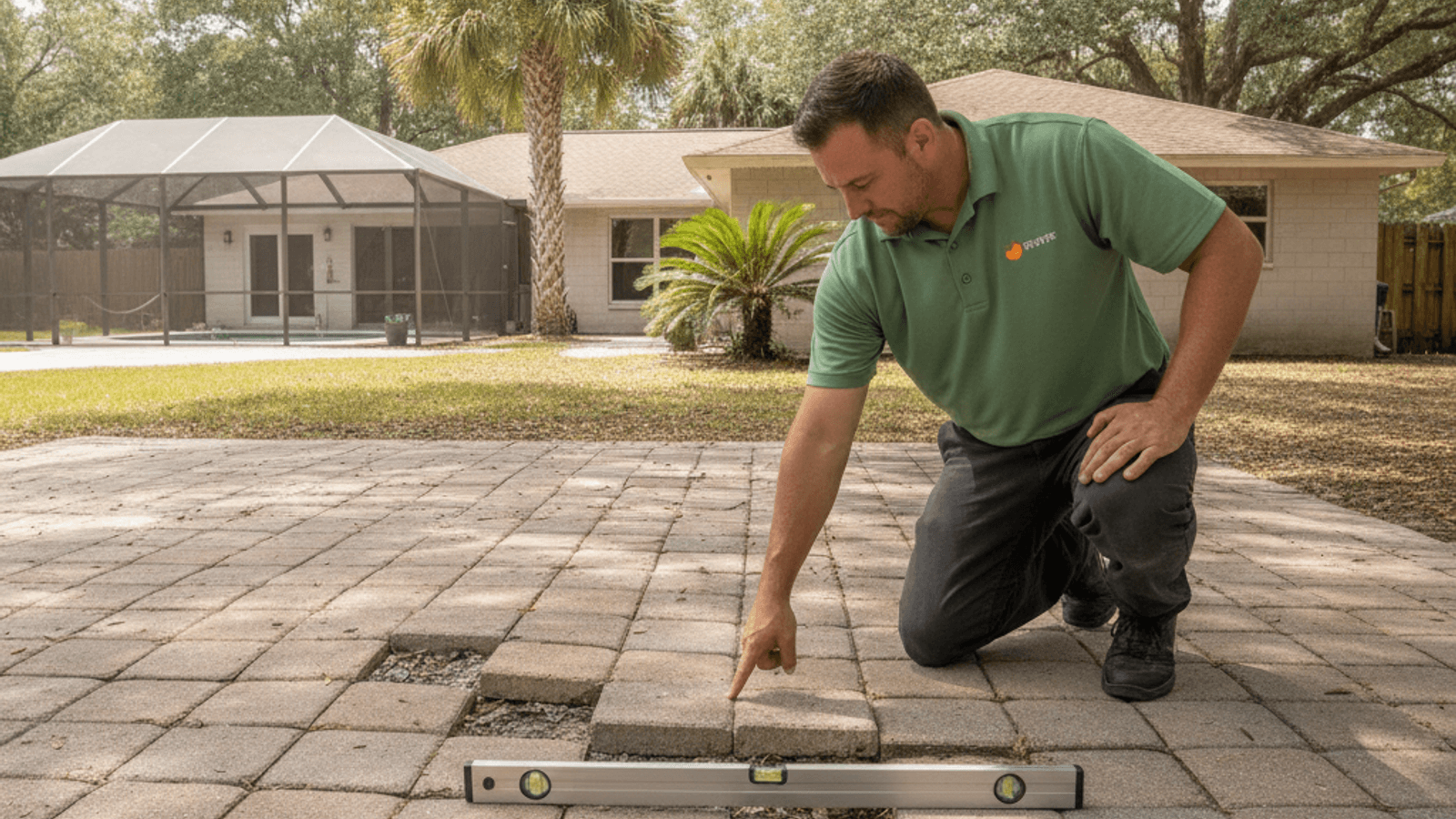
If you searched for why your paver patio is sinking or shifting, you’ve probably already found articles talking about freeze-thaw cycles pushing pavers out of alignment. That’s not what’s happening in your backyard. Central Florida doesn’t get freeze-thaw cycling, so a paver problem here has a different, and usually more fixable, root cause once you know what to actually look for.
The two real causes in Central Florida
Almost every sinking or shifting paver patio in Greater Orlando traces back to one of two things: the base underneath the pavers wasn’t compacted properly when it was installed, or water is eroding the sandy soil beneath the base over time. Sometimes it’s both at once, since a poorly compacted base is also more vulnerable to erosion once water starts moving through it.
Neither cause is about the pavers themselves being defective. The pavers are almost always fine. The problem is underneath them.
How base-prep failure shows up
A properly installed paver patio sits on several inches of compacted aggregate base, graded and compacted in layers before the pavers ever go down, plus a layer of bedding sand and proper edge restraint holding the whole field in place. When that base isn’t compacted thoroughly, either from a rushed installation or a crew skipping the compaction step to save time, the base continues settling under the weight of foot traffic and rain for months or years after installation, which is exactly what shows up as sinking or uneven pavers.
You can usually tell base-prep failure apart from erosion by where the problem shows up. Base-prep failure tends to create isolated low spots or dips scattered across the field, often worse in high-traffic areas like a walkway or under furniture legs, since that’s where the compaction load concentrates.
How sandy-soil erosion shows up
Central Florida’s sandy, fast-draining soil is great for keeping water from pooling, but that same fast-draining quality means water moving underneath or around a patio’s edge can wash sandy soil out from beneath the base over time, particularly if grading sends runoff toward the patio instead of away from it, or if edge restraint has failed and allows water to channel in along the perimeter. Erosion tends to show up differently than base-prep failure: pavers sinking or shifting mainly along one edge, near a downspout, or where the yard’s grade slopes toward the patio rather than away from it.
If you notice the shifting is worse after a heavy summer storm specifically, rather than a steady gradual sinking over time, erosion tied to drainage is the more likely culprit.
Why proper drainage matters as much as the base itself
Drainage and grading work hand in hand with paver base prep, and a patio installed with a perfect base but poor drainage planning can still develop erosion-driven shifting within a couple of years. The fix in that case isn’t repouring the base, it’s correcting where water goes before it ever reaches the patio, whether that means regrading the yard, adding a French drain along the problem edge, or extending a downspout further from the patio’s perimeter.
This is also why a patio that looked fine for its first year or two, then started shifting after a particularly wet summer, often points to a drainage issue rather than an installation defect. The base may have been fine originally; it’s what’s happening around it now that changed.
How the fix differs based on the cause
A base-prep failure usually means lifting the affected pavers, excavating and properly recompacting the base in that section, and resetting the pavers with fresh bedding sand and joint sand. This is a solvable, contained repair when the isolated area is caught early, rather than something that requires tearing out the whole patio.
An erosion-driven problem needs the water issue solved first, or any repair to the pavers themselves will just fail again within another storm season or two. That might mean addressing grading, adding drainage, or extending a downspout before touching the pavers at all. Skipping that step and just resetting the affected pavers without fixing what’s washing the soil out from underneath them is the single most common reason a paver repair doesn’t hold.
When it’s actually a whole-patio problem, not a spot repair
If the shifting is widespread across the entire patio rather than isolated to one section or edge, that usually points back to base compaction that was inadequate across the whole original installation rather than a localized drainage issue. In that case, a full base rebuild is the more honest fix, even though it costs more than a spot repair, because patching isolated sections of a patio with a systemic base problem tends to shift the problem to a different spot within another year rather than actually resolving it.
What to check before you call anyone
A few things worth noting before a contractor walks your yard: how long ago the patio was installed, whether the shifting is spread evenly or concentrated in one area, whether it got noticeably worse after a specific storm, and where your downspouts and yard grading direct water relative to the patio’s edges. Taking a few photos over a couple of weeks, especially right after a heavy rain, gives a contractor a much clearer picture than a single dry-day look at the problem, since erosion-driven shifting often isn’t obvious until water is actively moving through the area.
It’s also worth checking the joint sand between your pavers. Joint sand that’s visibly washed out or missing in patches, especially concentrated along one edge, is a strong sign that water is moving through the joints and carrying material away, which points toward a drainage-related cause rather than a base-compaction one.
Why waiting usually makes the repair bigger
A single sunken paver or a slightly uneven joint is a small, inexpensive fix caught early. Left alone, that same isolated issue tends to spread, since the same base or drainage problem causing it doesn’t resolve on its own and often gets worse with each subsequent storm season. Standing water pooling in a sunken low spot also creates a mosquito breeding concern in Central Florida’s climate, and a tripping hazard that becomes a real liability the longer it’s ignored. Catching the problem within the first season it appears, rather than living with it for a couple of years, is almost always the cheaper path.
A common pattern in newer Central Florida communities
Homeowners in fast-growing newer developments, including parts of Kissimmee and Horizon West, sometimes see paver issues show up within just a year or two of a new-construction patio, which often traces back to a builder-grade installation that didn’t compact the base to the standard an experienced hardscape crew would use. That’s frustrating on a relatively new patio, but it’s a diagnosable and fixable problem once someone actually digs down to see what’s underneath.
Why is my paver patio sinking in Florida if there’s no frost line here?
Central Florida doesn’t get freeze-thaw cycling, so sinking pavers here trace back to inadequate base compaction during installation or sandy-soil erosion from poor drainage, not frost heave.
Can I fix sinking pavers myself?
Lifting and resetting a small, isolated section is within reach for a confident DIYer, but diagnosing whether the cause is base compaction or drainage first is important, since resetting pavers without fixing the underlying water issue usually means the problem comes back.
How do I know if my paver problem is drainage-related?
Shifting concentrated along one edge, near a downspout, or that got noticeably worse after a heavy storm specifically usually points to drainage-driven erosion rather than a base-compaction issue spread evenly across the patio.
Does a new paver patio in Florida need special base prep compared to other regions?
Yes. Central Florida’s sandy, fast-draining soil requires proper compacted aggregate base depth and solid edge restraint to prevent settling and erosion, since the soil itself doesn’t hold a poorly prepared base the way denser clay soil sometimes can.
Dealing with sinking or shifting pavers and want an honest diagnosis before paying for a repair that might not hold? Call (407) 000-0000 and we’ll connect you with an experienced, insured local crew that checks the base and the drainage before recommending a fix.