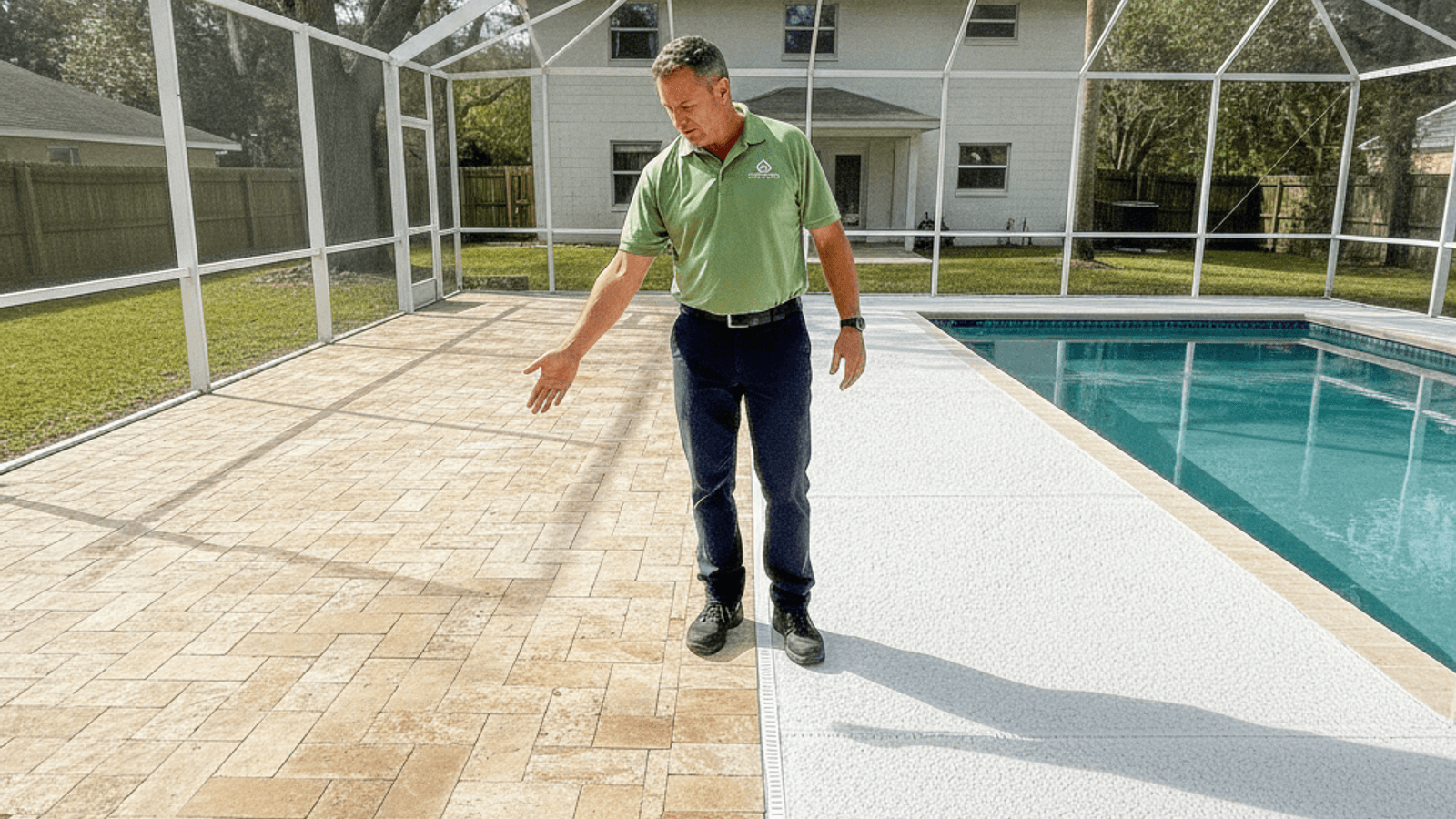
Walk through most residential neighborhoods in Orange, Seminole, or Osceola County and you’ll notice something that makes Orlando different from a lot of the country: the majority of backyards already have a pool. That changes the question homeowners are actually asking. It’s rarely “should I put in a patio,” and much more often “should I extend my patio with new pavers, or is my existing pool deck the thing that actually needs work?”
Those are two different projects with two different price points, and picking the wrong one wastes money on the surface that wasn’t the real problem.
What a new paver patio actually adds
A paver patio is new hardscape square footage, typically built off the back of the house, around a lanai, or extending an existing pool deck outward into the yard. It’s the right call when you’re short on usable outdoor space, want a defined area for a grill or seating that isn’t crowded against the pool cage, or you’re adding a feature like a fire pit or outdoor kitchen that needs its own footprint separate from the pool deck itself.
Because it’s new construction, a paver patio also means new base preparation from scratch, compacted aggregate base, proper edge restraint, and grading that moves water away from the house rather than toward it. Done right on Central Florida’s sandy soil, that base work is what determines whether the patio stays flat for a decade or starts shifting within a couple of years.
What pool deck resurfacing actually fixes
Pool deck resurfacing is a different job entirely. It doesn’t add square footage, it restores or upgrades the surface you already have around the pool, whether that’s a faded cool-deck coating that’s gone chalky and hot underfoot, cracked concrete that needs a paver overlay, or an outdated deck surface that just doesn’t match the rest of a renovated backyard anymore. If your existing deck is structurally sound but looks worn, cracked at the surface, or has become uncomfortably hot to walk on barefoot in July, resurfacing solves that without touching anything else in the yard.
This is usually the faster and less expensive of the two projects, since the existing slab and drainage are already in place and the work is largely surface-level rather than full excavation and base rebuild.
When the two projects actually overlap
Plenty of Orlando backyards need both, just not necessarily at the same time. A common sequence looks like this: a homeowner resurfaces a tired, cracked pool deck first to solve the immediate problem, then a year or two later adds a paver patio extension off to the side once budget allows, tying the new pavers into the resurfaced deck’s color and pattern so the whole space reads as one design instead of two separate projects bolted together.
Coordinating the paver color and pattern between a resurfaced deck and a new patio extension at the planning stage, even if the work happens in phases, avoids an awkward mismatch that becomes obvious the moment both are finished side by side.
The real cost difference
Pool deck resurfacing is generally the more budget-friendly option per square foot, since it’s working with an existing slab rather than building one. A new paver patio costs more per square foot because it includes full base excavation, compaction, edge restraint, and drainage work that a resurfacing project skips entirely. Neither number is fixed, and the honest range depends heavily on square footage, material choice, and whether drainage or grading issues need correcting as part of the job, which is exactly the kind of variable a written estimate from a local crew should walk through rather than a flat number pulled off a website.
Sandy soil matters more for new patios than for resurfacing
Because a paver patio is new construction built from the base up, it’s directly affected by Central Florida’s sandy, fast-draining soil in a way pool deck resurfacing usually isn’t. A patio poured on inadequately compacted sandy base is the single most common reason homeowners in communities like Winter Garden and Clermont end up calling about sinking or shifting pavers a couple of years after installation. Resurfacing an existing deck skips that risk almost entirely, since the slab underneath is already settled and proven.
Which project actually solves your problem
If your complaint is “we don’t have enough usable space out here,” a paver patio addition is the answer, since resurfacing an existing deck doesn’t create new square footage no matter how good the new surface looks. If your complaint is “this deck is cracked, faded, or too hot to walk on,” resurfacing solves that directly without the cost and disruption of a full new-construction patio project. And if the honest answer is both, sequencing the work and matching materials at the planning stage keeps the eventual combined result looking intentional rather than pieced together.
Material choices affect both projects differently
For a new paver patio, the material decision is wide open: standard concrete pavers, travertine, or textured brushed concrete pavers each carry a different price point and heat performance underfoot, which matters a lot in a Central Florida July when a dark surface can get genuinely uncomfortable to walk on barefoot. Travertine stays noticeably cooler in direct sun than standard concrete pavers, which is why it’s become a popular pick specifically for pool deck areas even though it costs more upfront.
Resurfacing works with a narrower set of options tied to what’s already there. A cool-deck acrylic coating is the standard refresh for an existing concrete pool deck and comes in a range of colors and textures designed to stay cooler than bare concrete. A paver overlay is also possible over an existing slab in some cases, effectively giving a resurfacing project the look of new pavers without the full excavation a ground-up patio requires, though a contractor needs to confirm the existing slab is a sound enough base to overlay before recommending that route.
Resale value and everyday livability both matter
Both projects show up in how a home shows to buyers, but they solve different problems for the people living there day to day. A resurfaced pool deck removes an obvious eyesore, the cracked, dated, or faded surface that’s usually the first thing a visitor notices walking into the backyard. A new paver patio changes how the space actually functions, giving a family more usable square footage for everyday life rather than just improving what’s already there. Homeowners planning to sell within a year or two often prioritize whichever project addresses the more visible problem first, while homeowners settling in for the long haul tend to weigh which one they’ll actually use more.
A note on HOA review for either project
Most Greater Orlando HOAs, especially in newer master-planned communities, require some level of architectural review before either a new patio or a visible deck resurfacing project, particularly if the new material or color changes the exterior appearance of the home. Confirming what your community requires before scheduling either project avoids a stop-work situation partway through.
Is it cheaper to resurface a pool deck or build a new paver patio?
Resurfacing an existing pool deck is generally less expensive per square foot than a new paver patio, since it works with the existing slab rather than requiring full base excavation, compaction, and drainage work from scratch.
Can I match new paver patio pavers to my resurfaced pool deck?
Yes, and coordinating the color and pattern at the planning stage, even if the two projects happen months or years apart, keeps the finished result looking like one cohesive backyard rather than two mismatched surfaces.
How do I know if my pool deck needs resurfacing or replacement?
A deck with surface-level cracking, fading, or a worn coating is usually a good resurfacing candidate. A deck with structural cracks running through the slab, visible heaving, or drainage that pools water against the house needs a full diagnosis before resurfacing, since a new coating won’t fix a structural or drainage problem underneath it.
Does a new paver patio need a permit in Orlando?
Most Central Florida counties require a permit for a new paver patio, particularly if it’s a significant addition or ties into existing drainage. Confirm requirements with your county building department and your HOA, if applicable, before work begins.
Not sure whether your backyard needs a new paver patio, a resurfaced pool deck, or both? Call (407) 000-0000 and we’ll connect you with an experienced, insured local crew that can walk your yard and give you an honest read before you spend a dollar on either.