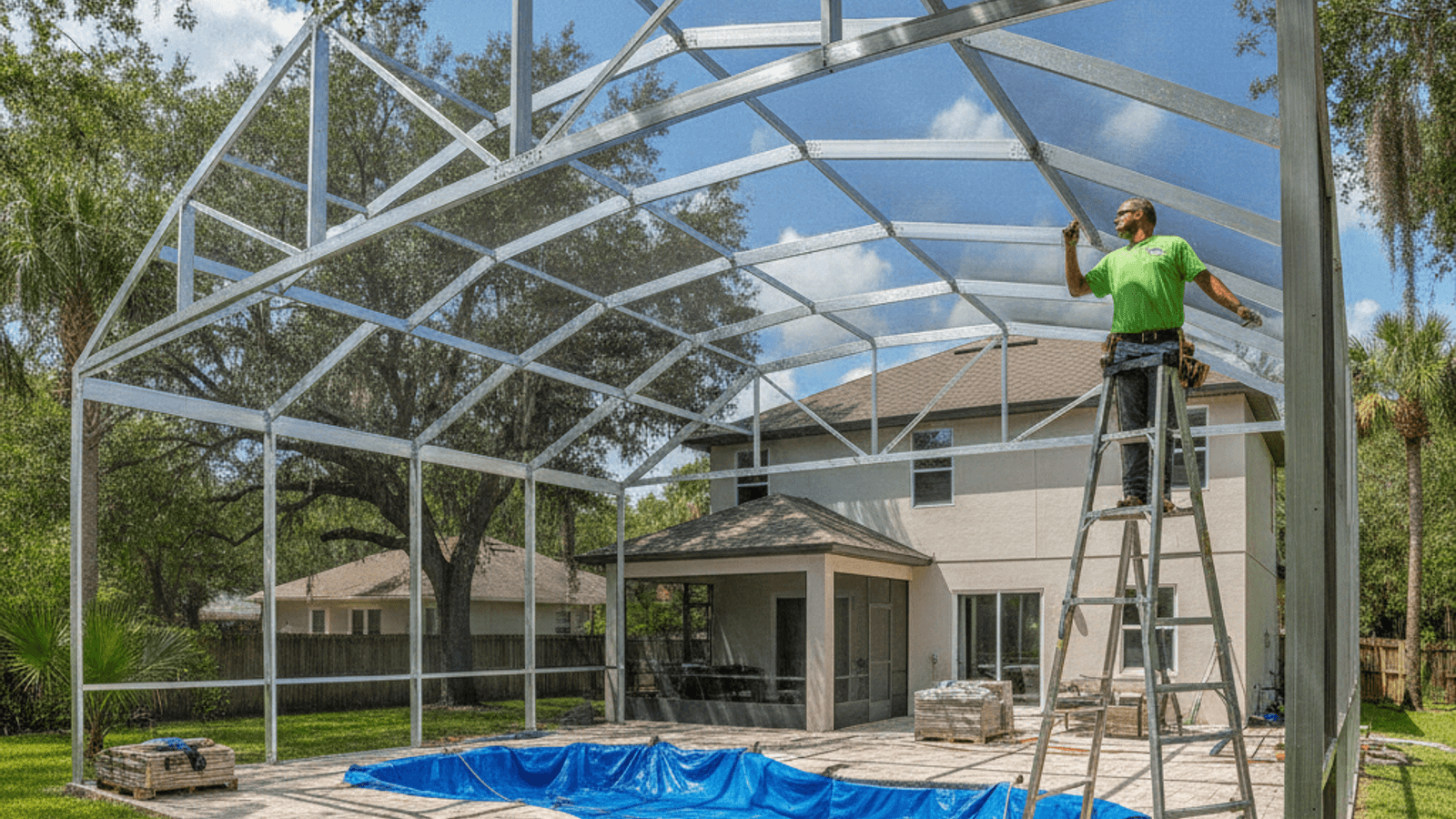
Ask around and you’ll get wildly different numbers for what a screened lanai or pool cage costs in Orlando. Some of that is normal quote variation, but a real chunk of it comes down to something most homeowners never hear explained clearly: wind-load engineering. A pool cage isn’t priced like a patio cover. It’s an engineered structure that has to meet Florida Building Code wind requirements for your specific address, and that requirement changes the materials, the framing, and the final number more than almost any other factor.
The price range you’ll actually see
Screened lanai and pool enclosure pricing varies with square footage, roof style (flat screen roof versus a domed or gable-shaped structure), aluminum frame gauge, and screen type, whether that’s standard fiberglass mesh, a no-see-um fine mesh for better bug protection, or a clear panoramic view screen that costs more but preserves the sightline instead of a visible mesh pattern. A basic flat-roof enclosure over a modest patio sits at the lower end of the range, while a large, tall, dome-roofed enclosure over a full pool and deck area with panoramic screen sits meaningfully higher. Any quote you get should break down square footage, roof style, and screen type separately, since lumping them into one number makes it hard to tell what you’re actually paying for.
Real numbers to work from
Most full screened lanai and pool enclosure projects in Greater Orlando land somewhere between $15,000 and $40,000, with the spread driven mainly by square footage and screen type rather than any single factor alone. A modest flat-roof enclosure over an existing pool deck sits toward the lower end of that range, while a large, tall, dome-roofed enclosure with panoramic clear-view screen over a big pool and deck area sits at the top of it. If pool deck resurfacing is part of the same project, that typically runs $8 to $20 per square foot on its own, separate from the enclosure cost.
Why wind load is the hidden cost driver
Every screened lanai built in Central Florida has to be engineered to withstand the wind speed Florida Building Code requires for that specific address, which in most of Orange and Seminole County runs roughly in the 140 to 150 mph ultimate design wind speed range, though your exact number depends on your address and your contractor should confirm it, not estimate it. Meeting that requirement means specific aluminum frame gauges, specific footing and anchoring details, and in some cases additional structural bracing that a lower-cost, non-permitted installation simply skips.
This is the single biggest reason two quotes for what looks like the same size enclosure can come in at meaningfully different numbers. The cheaper quote may be using lighter-gauge aluminum or skipping the engineering review that a permitted, code-compliant structure requires, which isn’t a savings, it’s a structure that’s more likely to fail in the first serious storm.
What drives the number up or down within that range
Height is a real cost factor, since a taller enclosure over a two-story lanai or a screened structure that needs to clear a tall roofline requires more material and more structural bracing than a standard single-story enclosure. Roof style matters too: a flat screen roof is the most economical option, while a domed, gabled, or hip-style roof costs more but sheds water and debris more effectively and often looks more integrated with the home’s architecture.
Screen type is the other major swing factor. Standard fiberglass mesh is the budget option. No-see-um mesh, useful in yards near standing water or heavy vegetation where tiny biting insects are a real nuisance, costs somewhat more. Panoramic clear-view screen, which uses a different weave to minimize the visible mesh pattern and preserve sightlines to the yard or a water feature, sits at the top of the range.
Pool deck condition affects the total project cost too
If your existing pool deck needs resurfacing as part of the same project, whether because it’s cracked, faded, or simply due for an update to match a new enclosure, that’s a separate cost from the enclosure itself and worth budgeting as its own line item rather than assuming it’s bundled into a lanai quote by default. Some contractors package both projects together for a coordinated install, which can simplify scheduling even though the two scopes of work are priced independently.
Why “we’ll get it cheaper” is often a wind-load problem in disguise
If one quote comes in dramatically lower than others for what appears to be the same size and style of enclosure, that’s worth asking direct questions about before signing anything: what aluminum gauge is being used, whether the structure is being engineered and permitted to current Florida Building Code wind standards for your address, and whether the quote includes the permit and engineering review at all. A significantly cheaper quote that skips permitting or uses under-spec materials isn’t actually the same product at a better price. It’s a different, riskier structure that happens to look similar until the first strong storm tests it.
Rebates and incentives: an honest note
Utility and manufacturer rebate programs for outdoor structures change frequently and aren’t something to count on as part of your budget math. If a rebate or incentive is available at the time you’re getting quotes, confirm the current amount and eligibility directly with the program rather than budgeting around a number you saw somewhere else, since these programs run out of funding or change terms without much notice.
Getting an accurate quote for your specific yard
Because so much of a screened lanai’s cost comes down to your address’s specific wind-load requirement, your existing deck condition, and the roof style your home and HOA allow, an accurate quote really does require someone measuring your yard and pulling your address’s wind data, not just a phone estimate based on square footage alone. Homeowners in HOA-governed communities across Winter Park and Dr. Phillips should also confirm architectural review requirements before finalizing a design, since some communities restrict roof style, screen color, or enclosure height.
How long a permitted enclosure project actually takes
Between design, HOA architectural review where applicable, county permitting, and engineering sign-off, a fully permitted screened lanai project in Central Florida typically takes several weeks before construction even starts, longer in communities with a monthly HOA board review cycle rather than a rolling one. Construction itself for a standard-size enclosure usually moves faster than the approval process leading up to it. Homeowners planning around a specific deadline, a pool party, a home sale, the start of the next hurricane season, should build that approval timeline into their planning from day one rather than assuming construction start date equals a quick turnaround.
Why do screened lanai quotes vary so much in Orlando?
Wind-load engineering requirements, which differ by exact address under Florida Building Code, along with square footage, roof style, and screen type, are the main reasons quotes for similar-looking enclosures can vary meaningfully.
Is a cheaper screened lanai quote ever a bad sign?
It can be. A quote dramatically lower than others may be using lighter-gauge aluminum or skipping the engineering and permitting required to meet Florida Building Code wind standards for your address, which is a real structural risk, not just a discount.
Does pool deck resurfacing cost extra on top of a lanai enclosure?
Yes, resurfacing an existing pool deck is a separate scope of work from building the enclosure itself, though some contractors coordinate both projects together if you need each done around the same time.
Are there current rebates for screened lanai or pool enclosure projects in Florida?
Rebate and incentive programs change and run out of funding regularly. Confirm current availability and amounts directly with the specific program at the time you’re getting quotes rather than assuming a rebate you’ve heard about is still active.
Ready to get an accurate quote based on your actual address and yard, not a generic estimate? Call (407) 000-0000 and we’ll connect you with an experienced, insured local crew that measures your yard and explains exactly what’s driving your number.