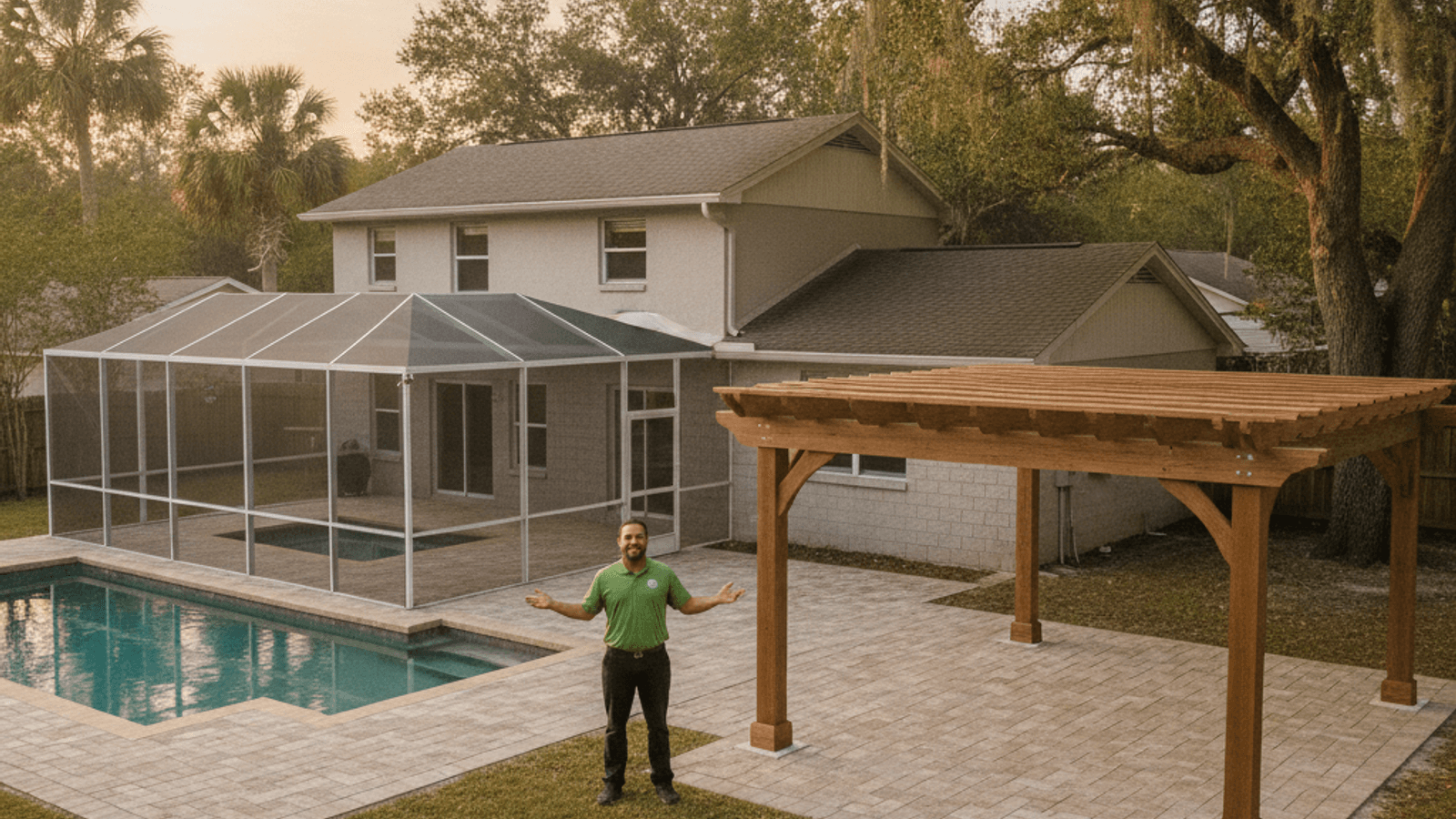
Both a screened lanai and a pergola give you a defined outdoor living space, and both show up constantly across Greater Orlando backyards. But they solve genuinely different problems, cost differently, and get treated differently by HOA architectural review boards. Picking between them isn’t really about which one looks nicer. It’s about what you actually need the space to do.
What a screened lanai actually solves
A screened lanai is a fully enclosed structure, typically covering a pool and deck area, built to keep insects out while still letting in light and airflow. In Central Florida, where mosquitoes and no-see-ums are a genuine year-round nuisance around any standing water, that bug barrier is the single biggest reason homeowners choose a lanai over an open structure. It also functions as a required pool safety barrier in many cases, which is a real factor for homeowners with young kids or pets and a pool.
The tradeoff is cost and visual openness. A full enclosure costs more than an open pergola of similar footprint, and the aluminum frame and screen, even with a panoramic clear-view option, changes the sightline to your yard compared to a completely open structure.
What a pergola actually solves
A pergola is an open shade structure, typically over a patio, seating area, or outdoor kitchen space that isn’t directly attached to the pool. It doesn’t keep bugs out, but it doesn’t need to if it’s not covering a pool deck where standing water and evening use make insects a bigger issue. What it does deliver is real shade from Central Florida’s intense sun, a defined outdoor room that still feels completely open to the yard, and a lower cost than a full lanai enclosure.
Pergolas also read differently architecturally. A cedar or aluminum pergola over a seating area or outdoor kitchen tends to blend more naturally into a backyard’s landscaping than an aluminum-framed screen enclosure does, which matters for homeowners prioritizing how the space looks from the yard rather than function alone.
Where a gazebo or pavilion fits into this decision
A gazebo or pavilion sits between the two, typically a fully roofed but open-sided structure rather than a flat pergola lattice or a fully screened enclosure. It offers more weather protection than an open pergola, since a solid roof sheds rain the way a lattice pergola doesn’t, without the cost or bug-barrier commitment of a full lanai. For a backyard feature away from the pool, like a freestanding seating or dining structure, a gazebo or pavilion is often the middle-ground answer homeowners land on once they’ve compared the other two.
HOA architectural review treats these differently
This is where the decision gets specifically local. Most Greater Orlando HOAs, especially in newer master-planned communities, have design guidelines that address enclosed structures differently than open ones. A screened lanai enclosure often faces more scrutiny in the architectural review process, since it’s a larger, more visually prominent addition that changes the home’s exterior appearance more significantly than an open pergola does. Some communities restrict enclosure height, screen color, or require the structure to match specific roofline styles, while open pergolas sometimes move through review faster since they’re seen as a lower-impact addition.
If you’re in a strict architectural review community, checking your specific HOA’s guidelines before committing to either option, rather than after a design is already drawn up, saves a redesign cycle partway through the review process.
Backyard layout usually decides this before HOA rules do
For most homeowners, the practical layout of the backyard settles the decision before HOA rules even become a factor. If the space you’re building over includes the pool, a lanai is almost always the more functional choice given the bug barrier and safety benefit. If the space is a separate patio, outdoor kitchen, or seating area away from the pool, an open pergola or a gazebo delivers the shade and defined space without the cost of full enclosure.
Can you have both?
Plenty of Greater Orlando backyards have both: a screened lanai over the pool and deck area, and a separate open pergola or gazebo over a different part of the yard, like a fire pit seating area or outdoor kitchen that doesn’t need bug enclosure. Homeowners in larger-lot communities like Windermere and Clermont often have the space to do exactly this, using each structure for what it does best rather than trying to make one do both jobs.
Maintenance differs more than most homeowners expect
An open pergola, especially a wood or cedar one, needs the same periodic staining and sealing attention any exterior wood structure needs in Central Florida’s humidity, roughly every one to two years to stay protected against sun and moisture. An aluminum pergola skips that maintenance cycle entirely but costs more upfront than wood.
A screened lanai’s maintenance is different in kind: the aluminum frame itself needs little attention beyond occasional cleaning, but the screen panels are the ongoing concern, since mesh degrades under years of UV exposure and can tear from debris, pets, or general wear. Budgeting for eventual screen panel replacement, typically every 7 to 10 years depending on mesh quality and exposure, is a real part of owning a lanai long-term that a pergola owner simply doesn’t deal with.
How each structure handles Central Florida’s daily summer storms
A pergola with an open lattice roof doesn’t fully block rain, which is fine for shade but means the space underneath still gets wet during Central Florida’s near-daily summer afternoon storms unless the pergola includes an added shade cloth or panel element. A solid-roofed gazebo or pavilion sheds rain completely, making it more usable during and right after a storm. A screened lanai, if it has a solid roof panel rather than just screen overhead, offers the same rain protection while also keeping bugs out, which is part of why lanais see heavier daily use in households that spend a lot of time outdoors regardless of weather.
Cost comparison at a glance
A screened lanai enclosure typically runs $15,000 to $40,000 depending on size and screen type, while a pergola generally lands in the $4,000 to $15,000 range depending on size, material, and any added shade element. That gap is a real factor for homeowners deciding between the two when budget, not just function, is part of the equation.
Is a screened lanai or pergola better for a pool area?
A screened lanai is almost always the better fit for a pool area specifically, since it delivers bug protection and often functions as a pool safety barrier that an open pergola doesn’t provide.
Do Orlando HOAs treat pergolas and screened lanais differently?
Often, yes. Many HOA architectural review processes scrutinize enclosed structures like a screened lanai more closely than an open pergola, since the enclosure changes the home’s exterior appearance more significantly. Check your specific community’s guidelines before finalizing a design.
Can I have both a pergola and a screened lanai in the same yard?
Yes, and it’s a common setup on larger Greater Orlando lots: a lanai enclosing the pool and deck area, and a separate open pergola or gazebo over a patio, fire pit, or outdoor kitchen area that doesn’t need bug enclosure.
Is a gazebo cheaper than a screened lanai?
Generally, yes. A gazebo or pavilion typically costs less than a full screened lanai enclosure, since it doesn’t include the aluminum screen framing and bug barrier a lanai requires, while still offering more weather protection than an open pergola lattice.
Trying to decide between a screened lanai, a pergola, or a gazebo for your specific yard and HOA? Call (407) 000-0000 and we’ll connect you with an experienced, insured local crew that can walk your property and talk through what actually fits.