If you grew up anywhere with a real winter, you probably learned that footings have to go below the frost line so the ground freezing and thawing doesn’t heave them out of place. Central Florida doesn’t have that problem. The ground here almost never freezes, so frost depth isn’t the number that matters. What matters instead is how much weight the sandy soil under your yard can actually carry, and how hard a Central Florida storm can pull upward on a pergola or deck post before it lets go.
That’s a different engineering question, and it changes how a footing gets sized here compared to almost anywhere up north.
Why frost depth isn’t the driver here
In climates with real winters, footings go 36 to 48 inches deep specifically to sit below the point where the ground freezes solid. Orange, Seminole, Osceola, and west Lake county soil doesn’t freeze in a normal winter, so there’s no frost line pushing footings deeper than the structure actually needs. A contractor quoting a Central Florida pergola off a frost-depth chart from another region is quoting the wrong number.
What replaces frost depth as the controlling factor is a combination of two things: how much the loose, sandy soil under a typical Orlando-area yard can bear without settling, and how strongly a hurricane-season gust can try to lift the whole structure off its posts.
Sandy soil changes the bearing math
Most of Greater Orlando sits on sandy, fast-draining soil, part of why standing water disappears from a yard within a day or two after a storm in well-graded areas. That same sandy structure that drains well also compacts differently than the denser clay soils common in other parts of the country. Loose sand has lower bearing capacity than compacted clay or rock, meaning a footing needs more surface area, not necessarily more depth, to spread the structure’s weight without settling unevenly over a few years.
This is why a contractor experienced with Central Florida soil often widens a footing’s diameter rather than just chasing extra depth. A 12-inch diameter footing might work fine on stable soil elsewhere, but the same load on loose Central Florida sand often calls for an 18 to 24 inch diameter pad instead, sometimes paired with a slightly wider base than top to resist both settling and uplift.
Wind uplift is the real design driver
A pergola isn’t just sitting under gravity the way a shed or a fence post is. During a strong Central Florida storm, wind moving across and around an open pergola roof structure creates real uplift force trying to pull the whole frame upward off its posts, similar to how wind lifts an airplane wing. That uplift force, not the weight of the structure itself, is usually the number an engineer designs the footing and post connection around.
Orange and Seminole county inland areas typically fall in the range of roughly 140 to 150 mph ultimate design wind speed under current Florida Building Code wind maps, though the exact number depends on your specific address and a contractor pulling permits should confirm it rather than estimate it. That wind speed feeds directly into how deep the footing needs to be, what diameter it needs, and what kind of post base hardware anchors the wood or aluminum post to the concrete.
Typical footing depth ranges for Central Florida
For a standard residential pergola on stable, well-drained sandy soil, footings commonly run 24 to 36 inches deep, sized more by diameter and reinforcement than by chasing extra depth the way a frost-line footing would. Larger structures, taller posts, or sites with looser fill soil sometimes need footings closer to 36 to 42 inches, occasionally paired with a helical pile or engineered pier system if a soil test shows the native sand won’t hold a standard concrete footing reliably.
A raised composite or wood deck with a similar post spacing generally follows the same logic, though deck footings usually see less uplift stress than an open pergola roof structure since a deck doesn’t catch wind the same way an elevated roof plane does.
Why a soil test matters more here than depth alone
Fill soil is common on newer Central Florida lots, especially in fast-growing communities like Horizon West and parts of Osceola County where large tracts were graded and built out over a short window. Fill soil doesn’t always compact as reliably as native, undisturbed sand, and a footing that would be plenty deep in stable native soil can settle unevenly if it’s poured into loosely compacted fill without checking first.
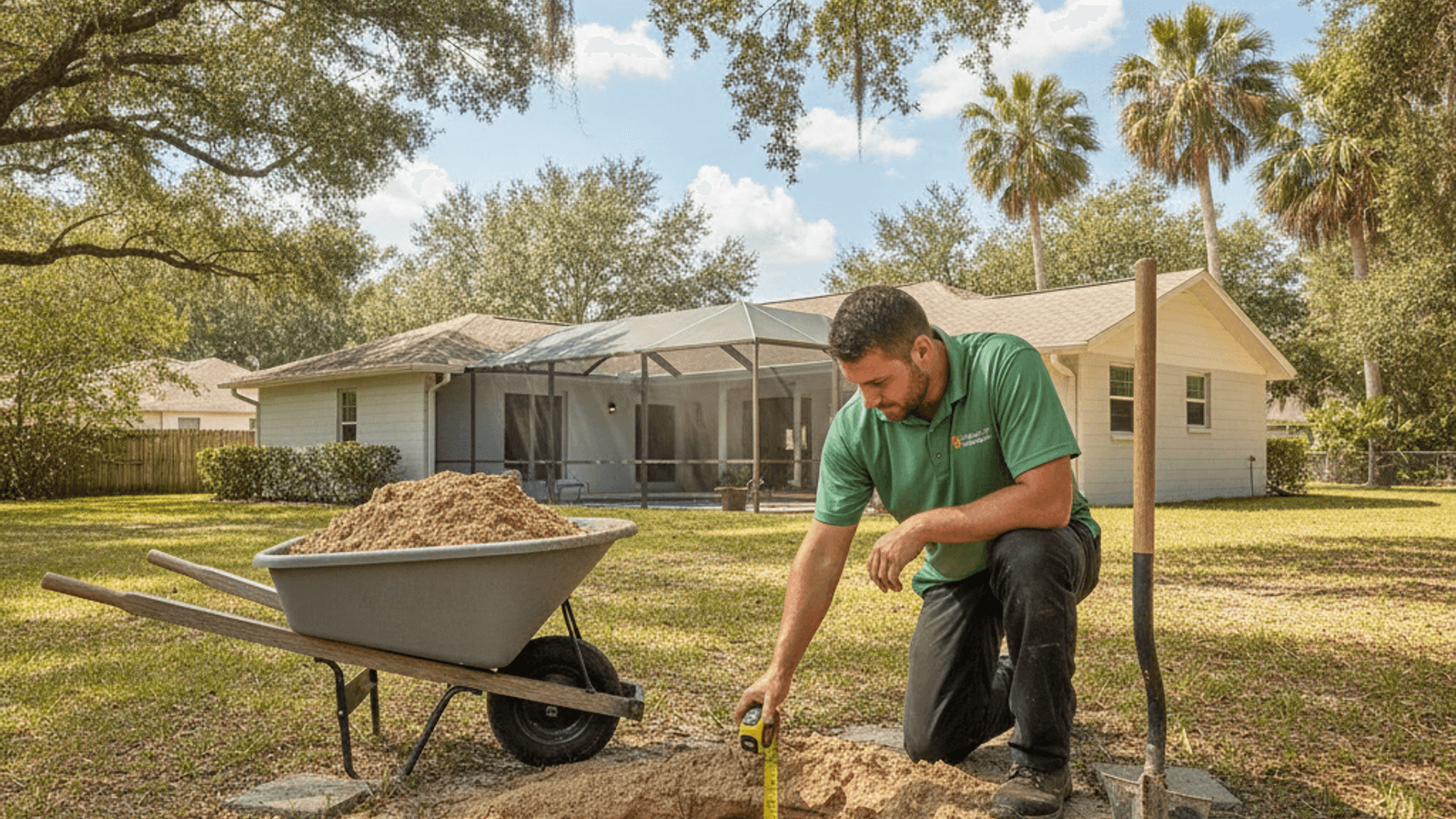
A contractor who digs the first footing hole and actually looks at what comes out, whether it’s consistent sandy soil or a mix of fill material, is doing something that protects you from a problem that won’t show up until the structure has been standing for a year or two and starts to lean.
The same sandy-soil logic applies to retaining walls
If your yard has any real grade change, common out toward the rolling terrain of west Lake County near Clermont and Minneola, you’ll run into the same sandy-soil bearing question with a retaining wall that you do with a pergola footing. A retaining wall over a couple of feet tall is holding back loose, saturated soil after a heavy storm, and an undersized base or missing drainage behind the wall lets water pressure build up and push the wall out over time. The engineering conversation is different from a pergola footing, since a retaining wall is resisting lateral pressure rather than uplift, but the starting point is the same: know what the soil under and behind the structure actually does before you pour anything.
Concrete piers versus helical piles
Standard poured concrete footings handle most residential pergola and deck projects fine once they’re sized correctly for the soil and wind load. But on a lot with inconsistent fill soil, a high water table, or a spot where a soil test shows the native sand won’t reliably hold a standard footing, some contractors switch to helical piles instead, screwed mechanically into stable soil below the loose surface layer rather than relying on a poured footing’s mass and surface area alone. Helical piles cost more upfront than a standard concrete footing, but they remove the guesswork on a difficult lot and install without the wait time a concrete cure requires, which matters if your project is on a tight schedule ahead of a specific date.
Most Central Florida counties require a permit for a pergola or elevated deck attached to or standing near the home, and the footing design is exactly what the county building department is reviewing when that permit gets pulled. A homeowner in a community like Lake Nona or Horizon West with an active HOA architectural review process will typically need the footing and post-anchoring details on the submitted plans before the county or the HOA signs off, so getting this number right isn’t just a structural question, it’s what keeps a project moving through approval without a second review cycle.
What can go wrong when footings are undersized
An undersized or too-shallow footing usually doesn’t fail on a calm day. It fails during the first real storm, when wind uplift exceeds what the footing and post connection were built to resist, and a pergola post pulls partly out of the ground or the whole structure racks and leans. By the time that’s visible, the fix usually means excavating and repouring the footing properly rather than a quick patch, which costs far more than getting the depth and diameter right the first time.
How deep should a pergola footing be in Central Florida?
Most residential pergola footings here run 24 to 36 inches deep, sized more by diameter and wind-uplift resistance than by frost depth, since Central Florida doesn’t have a frost line to dig below.
Does Florida require a permit for a pergola?
Most Central Florida counties require a building permit for a pergola attached to or standing near a home, and the footing and post-anchoring design is a core part of what gets reviewed during permitting.
Why does wind matter more than weight for pergola footings here?
An open pergola roof creates real uplift force during storm-season wind, similar to how wind lifts an airplane wing, and that uplift force is usually the number a footing and post connection get engineered around, not just the structure’s static weight.
Can I dig my own footings for a DIY pergola?
Digging is fine, but sizing the depth, diameter, and post-anchoring hardware correctly for Central Florida’s sandy soil and wind-load requirements is not something to guess at, since an undersized footing usually doesn’t fail until the first real storm.
Planning a pergola or deck and want the footing sized right for your soil and your address’s actual wind-load number the first time? Call (407) 000-0000 and we’ll connect you with an experienced, insured local crew that pulls the permit and gets the engineering right before the first shovel goes in.