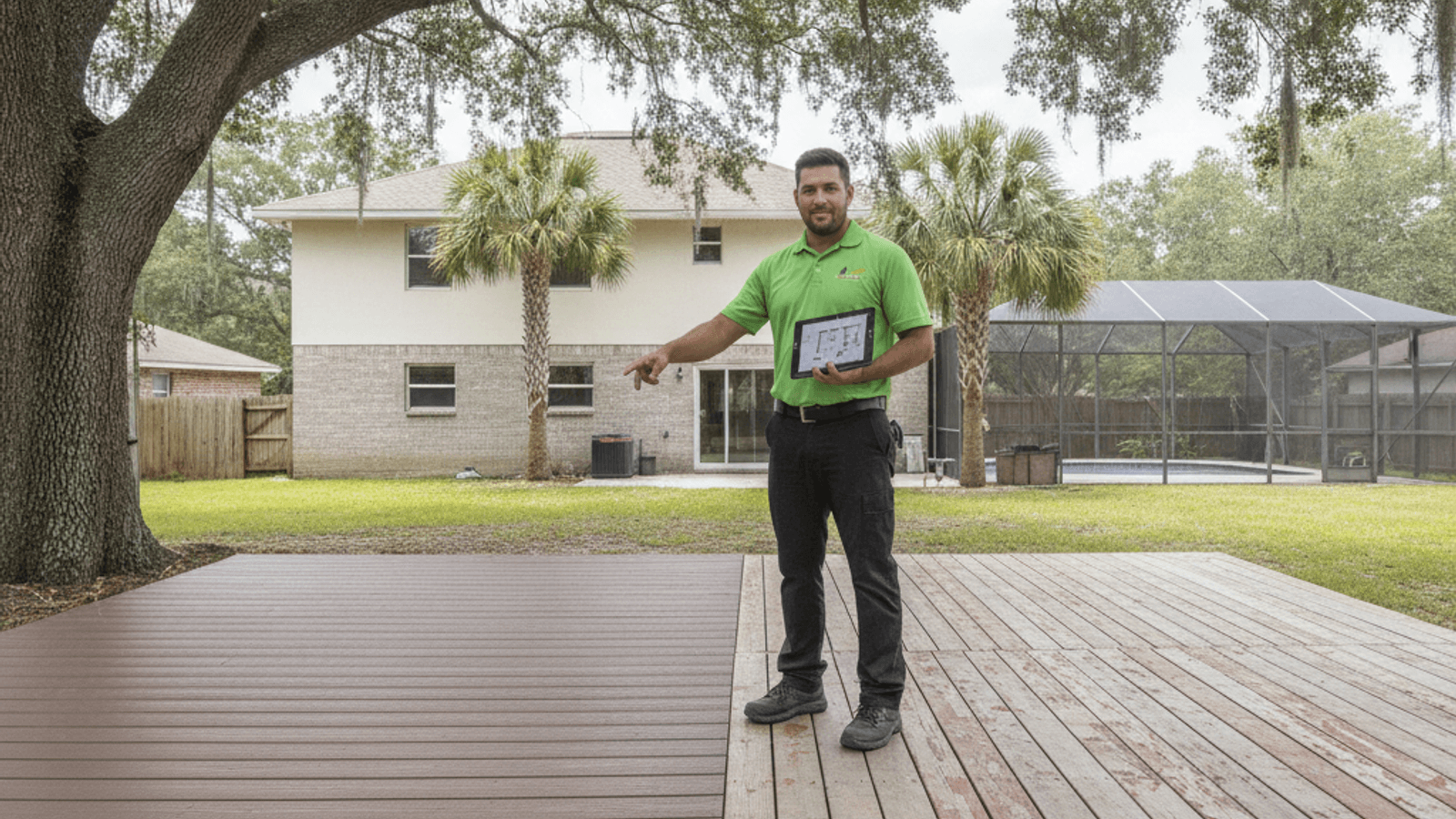
A deck material decision that works fine in a dry climate can play out very differently in Central Florida, where humidity sits high for most of the year, direct sun is intense nearly every month, and daily summer storms mean wood spends a lot of its life either soaked or drying out. Composite and wood decking both hold up here, but they age in different ways, and the maintenance commitment between them is where most homeowners end up making the wrong call if they only compare sticker price.
How humidity actually affects wood decking
Wood decking, whether pressure-treated pine or a hardwood like ipe, is a natural material that expands and contracts with moisture. Central Florida’s humidity rarely lets wood decking fully dry out between rain events for much of the year, and that constant moisture cycling is what drives mold, mildew, and gray weathering faster here than in drier climates. A wood deck that would need restaining every three to four years somewhere with lower humidity often needs it closer to every one to two years here to stay protected and keep its color.
Skipping that maintenance doesn’t just cost you appearance. Untreated or under-maintained wood decking in a humid climate is more prone to soft spots, splintering, and fastener corrosion over time, all of which eventually become structural concerns rather than cosmetic ones.
How UV and sun exposure affect composite decking
Composite decking doesn’t have the moisture-absorption problem wood does, since it’s built from a wood-plastic composite that resists rot, mold, and splintering by design. But Central Florida’s intense, near-constant sun exposure is still a real factor for composite boards. Lower-grade composite decking without a strong UV-stable capstock can fade or chalk noticeably over several years of direct Florida sun, and darker composite colors run measurably hotter underfoot on a summer afternoon than lighter colors do, which matters for anyone walking a pool deck area barefoot.
Higher-quality capped composite products handle Florida sun exposure well and are specifically engineered against UV fading, which is why the composite tier you choose matters more here than it might in a milder climate.
The maintenance-year math
This is where the real comparison lives. A pressure-treated wood deck typically costs less upfront than composite decking of similar size, but factoring in restaining or resealing every one to two years in Central Florida’s humidity, plus periodic board replacement as sections weather unevenly or splinter, the maintenance cost over a 10 to 15 year span adds up. Composite decking costs more at installation but requires essentially no staining or sealing, generally just periodic cleaning, which shifts the lifetime cost picture in composite’s favor the longer you plan to keep the deck.
Homeowners planning to own the home for five years or less, or who genuinely enjoy the maintenance ritual and the look of natural wood, often still choose wood and accept the upkeep. Homeowners planning to stay long-term, or who want a deck that looks the same in year eight as it did in year one without a recurring project on the calendar, tend to lean composite once they see the real maintenance-year comparison rather than just the installed price.
Mold and mildew are a bigger factor here than most places
Central Florida’s combination of high humidity, shade from oak and palm canopy in many established neighborhoods, and daily summer rain creates ideal conditions for mold and mildew growth on any deck surface that isn’t cleaned and maintained. Wood decking is more susceptible since mold can penetrate the wood grain itself, not just sit on the surface, which is part of why a wood deck in a shaded backyard needs more frequent attention than one in full sun. Composite decking resists mold penetration into the material itself, though surface mildew can still develop and needs periodic washing to prevent staining, particularly in shaded or low-airflow areas of the deck.
What restaining a wood deck actually involves
If you’ve already got a wood deck and it’s showing gray weathering, deck repair and restaining starts with a thorough cleaning and often light sanding to remove the weathered surface layer, followed by a stain or sealant rated for exterior use in high-UV, high-humidity conditions. Skipping the prep step and just applying a fresh coat over weathered, dirty wood is the most common reason a restain job looks good for a few months and then fails early, peeling or blotching within a year instead of holding for the two to three years a properly prepped job should last.
Fastener and framing choices matter as much as the decking itself
The visible boards get most of the attention in a wood versus composite comparison, but the framing and fasteners underneath matter just as much in a humid climate. Standard steel fasteners corrode faster in Central Florida’s humidity than they would in a drier region, which is why hot-dip galvanized or stainless hardware is worth the small upcharge on either a wood or composite deck. The same goes for the structural framing itself: pressure-treated framing lumber rated for ground contact and fastened with corrosion-resistant hardware holds up under a composite deck surface just as it would under wood, since the composite boards on top don’t change what the humidity is doing to the frame underneath.
A deck in a shaded, low-airflow yard, common in older, tree-canopied neighborhoods like College Park and parts of Winter Park, holds moisture against the framing longer than a deck in an open, sun-exposed newer community, which is one more reason a contractor familiar with your specific neighborhood’s tree cover and airflow pattern gives a more accurate maintenance estimate than a generic quote.
Cost realities for both materials
Neither wood nor composite decking has one fixed price, since both vary by board grade, deck size, height, railing style, and structural complexity. What’s consistent is the pattern: wood decking installs cheaper and costs more over time in upkeep, while composite decking installs at a higher price point and costs less to maintain year over year. A contractor quoting either project should walk through that tradeoff honestly rather than just quoting the lowest number on the install.
Which one actually fits your backyard
If your deck sits in full Florida sun most of the day, composite with a quality UV-stable capstock generally holds its color and resists the heat-and-fade cycle better than wood. If it’s shaded by oak canopy, both materials need attention to mold and mildew, though composite requires less intervention to manage it. And if the deck surrounds a pool where bare feet are walking across it regularly, color choice matters as much as material choice, since a dark composite or a dark-stained wood surface can both get uncomfortably hot in direct July sun.
Does composite decking fade in Florida sun?
Lower-grade composite without a strong UV-stable capstock can fade or chalk over several years of intense Florida sun exposure. Higher-quality capped composite products are specifically engineered to resist that fading and generally hold their color well long-term.
How often does a wood deck need restaining in Florida?
Central Florida’s humidity typically shortens the restaining interval to every one to two years, compared to every three to four years in drier climates, to keep the wood protected from moisture and UV damage.
Is composite decking worth the higher upfront cost in Florida?
For homeowners planning to stay long-term, composite’s near-zero staining and sealing requirement usually makes it the better value over a 10 to 15 year span, even though it costs more to install than wood.
Does mold grow on composite decking in humid climates?
Composite resists mold penetrating into the material itself better than wood does, but surface mildew can still develop, especially in shaded or low-airflow spots, and needs periodic washing to prevent staining.
Weighing composite against wood for a new deck, or need an honest read on whether your existing wood deck needs restaining or replacement? Call (407) 000-0000 and we’ll connect you with an experienced, insured local crew that can walk you through the real maintenance-year math for your specific yard.